Case study
Job Lens
Status: LiveA data-viz app showing what the job market is asking for: skill demand, role breakdowns and top hiring companies, extracted from real job postings via LLM.
- Role
- Solo developer
- Timeline
- July 22–24, 2026
Stack
- Next.js 16
- React 19
- TypeScript
- Tailwind CSS 4
- Python
- OpenAI API
Problem
Job postings describe what employers are hiring for, but that information is locked in unstructured text spread across thousands of listings. Job Lens turns a sample of real postings into a structured view of what skills are actually in demand, how that demand shifts by role, and which companies are doing the hiring.
Product decision
Job Lens is built as a static, offline-first product rather than a live query tool. The skill extraction runs once as a batch pipeline and its output is committed as JSON, and the frontend statically imports that JSON at build time with no runtime API or database. This trades live freshness for a simpler, more reliable architecture. The deployed site has zero runtime dependencies and nothing that can fail at request time.
User flow
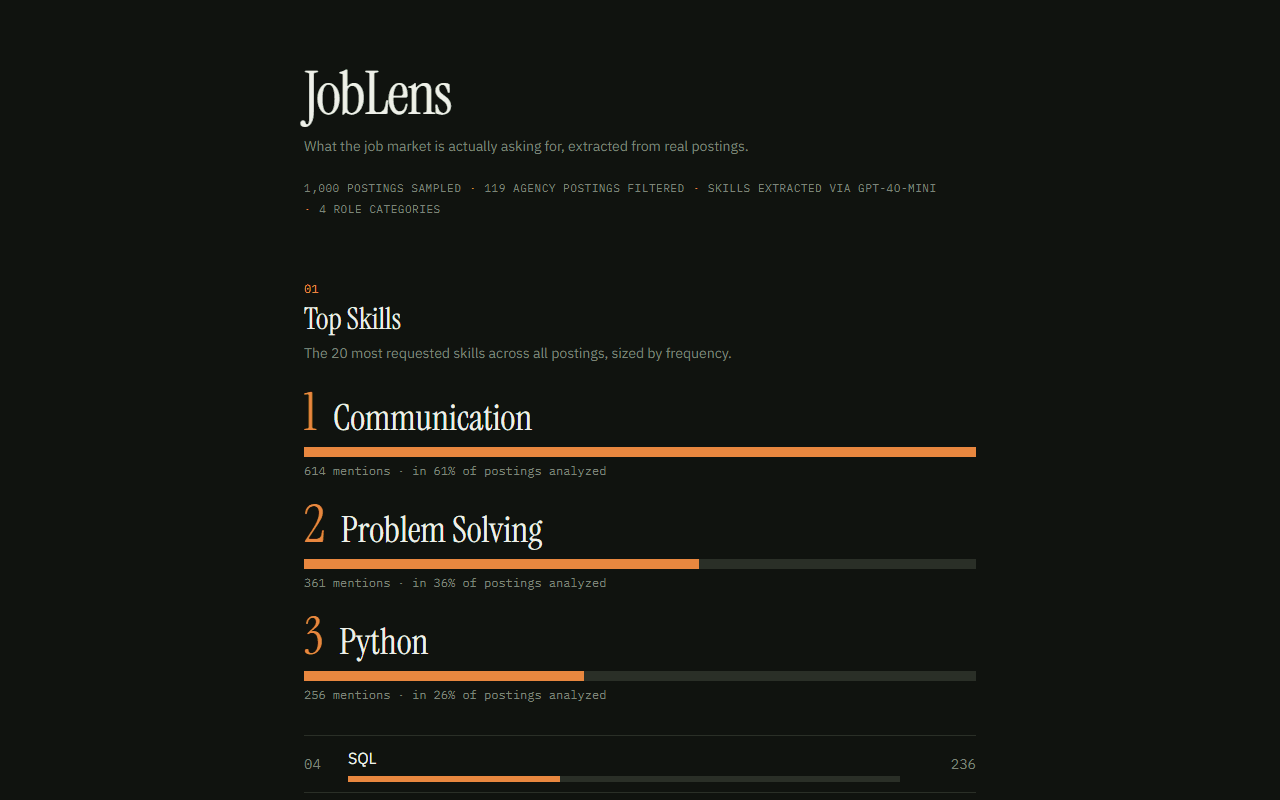
- A visitor lands on the page and sees three sections: Top Skills, Skills by Role and Top Hiring Companies.
- Top Skills shows the 20 most requested skills across all sampled postings, ranked and sized by frequency.
- Skills by Role lets the visitor switch between four role categories to see how required skills shift by role.
- Top Companies lists the employers with the most postings in the sample, with staffing and recruiting agencies filtered out.
- All three sections render directly from pre-computed JSON with no client-side fetching.
Technical architecture
Job Lens has two independent halves. Offline, a Python pipeline (scripts/extract_skills.py) reads a 1,000-posting sample drawn from a 124k-row LinkedIn postings dataset, calls the OpenAI API once per posting to extract structured skills, and aggregates the results into three output JSON files. Online, a static Next.js App Router frontend imports those JSON files directly at build time and renders them as three data-viz sections, with no server route, database or client-side data fetching involved.
- CSV of sampled postings
- gpt-4o-mini extraction (per posting)
- aggregated JSON (top skills / by role / top companies)
- committed to repo
- Next.js static import
- rendered charts
Implementation details
The pipeline sends each posting's title and description to gpt-4o-mini in JSON mode at temperature 0, asking for 5-15 categorized skills per posting (language/tool/framework, soft skill, certification or other) with instructions to normalize variant names (e.g. "Python3" to "Python"). Raw per-posting results are cached to data/output/raw_results.json so the aggregation step can be re-run without re-hitting the API.
During aggregation, skills are grouped for counting by a normalized key (lowercased, punctuation stripped) while keeping the first-seen raw phrasing as the display label, so minor naming variants collapse into one entry without losing readable formatting. A hardcoded list of ~40 known staffing and recruiting agencies is filtered out before counting, since those postings are placed on behalf of an undisclosed end employer and would distort both the skills and companies views. The three output JSONs (top_skills.json, skills_by_role.json, top_companies.json) are committed to the repo and consumed directly by the frontend.
The frontend is a single static page built from three presentational components (TopSkills, SkillsByRole, TopCompanies) on a custom editorial/monospace design system, with a custom OG image and favicon generated in-app.
Hardest technical issue
The main design problem was making per-posting company names usable for aggregation without a canonical company database. The same real employer can appear under several string variants across postings, and recruiting agencies post on behalf of employers they don't name. The pipeline addresses the second problem directly with a maintained agency exclusion list, but does not attempt fuzzy-matching or canonicalizing raw employer name variants, so the top-companies view is only as clean as the source data's naming consistency.
Validation and error handling
- The extraction script has a --test mode that runs on 20 rows and prints raw output without writing files, for checking prompt output before a full run.
- Per-posting extraction failures are caught and logged with the job_id, and that posting is skipped rather than failing the whole run.
- An --aggregate-only mode re-runs aggregation from the cached raw results without calling the API again.
- The frontend has no runtime error paths to handle, since all data is statically imported at build time rather than fetched.
- There is no automated test suite for either the pipeline or the frontend.
Privacy and data handling
Job Lens processes a third-party job postings dataset, not user-submitted or personal data. Postings are sent to the OpenAI API for skill extraction as part of the offline pipeline; there is no user-facing input and no data collected from site visitors. The OPENAI_API_KEY in the repo's .env is used only for offline pipeline re-runs and is not exposed to the deployed frontend.
Limitations
- The dataset is a static, one-time 1,000-posting sample; there is no automation to refresh it or re-run the pipeline on a schedule.
- Company names are not canonicalized beyond the staffing-agency exclusion list, so naming variants for the same employer may be undercounted or split.
- There is no automated test suite or CI for either the extraction pipeline or the frontend.
- Skill extraction quality depends entirely on the underlying model's output and is not validated against a ground-truth labeling.
- The role classification reuses the source dataset's existing role_category column rather than being independently derived.
Results
Ran the extraction pipeline end-to-end across all 1,000 sampled postings, producing three aggregated views (top skills, skills by role, top hiring companies) with 119 staffing-agency postings filtered out of the company and skill counts. Built and deployed a static Next.js frontend rendering all three views with a custom editorial design system.
No verified visitor or usage metrics are currently available.
Next steps
Still deciding between leaving Job Lens as a static one-shot analysis or building automation to periodically re-sample postings and re-run the extraction pipeline, which would also require adding tests and a CI pipeline currently absent.